Thursday, 4 April 2024

Residents Left Homeless: The Heartbreaking Tale of Tillicoultry's RAAC Victims

Desperate families have been made homeless after the seizure of their condemned buildings.

Please join the UK RAAC CAMPAIGN GROUP on Facebook!

In the heart of Clackmannanshire lies Tillicoultry, a serene village that was once home to Lynsey McQuater and several other homeowners. However, in 2023, their lives were upended in the most distressing manner imaginable.  Learn more about the 30 homes affected by RAAC in Clackmannanshire (here)

Lynsey recounts the chilling events of October 11th, 2023, when a letter, hand-delivered by the local council, shattered the tranquility of Tillicoultry's streets. The ominous notice proclaimed the necessity of inspecting all homes in the area for RAAC (Reinforced Autoclaved Aerated Concrete), a term that would soon become synonymous with anguish for the residents.

Within a mere three hours of dispatching the letter, council officers, accompanied by law enforcement, descended upon Lynsey's neighborhood. Armed with a warrant under the Buildings (Scotland) Act 2003, they issued an ultimatum: vacate the premises within two hours, taking only essentials for a fortnight's stay elsewhere. This abrupt expulsion marked the beginning of a nightmare for Lynsey and her neighbors. It should be noted that Lynsey, who had lived in her property for 23 years, had only 2 years left on her mortgage, adding another layer of distress to the harrowing situation.

"I had been staying with my mum, who was recovering from endometrial cancer surgery," Lynsey recalls, her voice trembling with emotion. "I found out the next morning from a neighbour, and it was too late to salvage any belongings as the block of flats was boarded up by the time I got there. When I phoned the council that day, I was informed that the police had to break entry to my home to ensure no one was inside. The council had changed my locks and had my new keys, assuring me that they would hand-deliver my notices in person. However, my notices were only sent by email on the 12th of October 2023, with no mention of my keys."

Tillicoultry has become a ghost town.

Evacuated residents were provided with three names from the council as points of contact that day, but two of the officers were on annual leave for a fortnight. Two weeks later, they were required to provide two lists: one for their immediate belongings and another for items to be placed in storage. Removal men and council workers entered their homes, as they were not allowed, and removed their belongings (although Lynsey's house keys were lost while in the council's care during this time). Lynsey had to give permission for them to break back into her home and change the locks, which was incredibly upsetting and traumatizing, causing heightened stress levels. She recalls breaking down and crying constantly, feeling overwhelmed by the situation. To have their items stored, they were told they had to make themselves homeless, and if they didn't, they would have to pay for storage themselves. The stress became unbearable, leading Lynsey to seek help from a doctor who signed her off work due to stress. She found it difficult to cope with normal day-to-day tasks, experienced insomnia, and was constantly in tears.

Forced to seek alternative accommodations, Lynsey has been staying with her mum for the last six months. Meanwhile, her other neighbors have been dispersed, with some staying with family members, others placed into homeless accommodation, and some relocated to bedsits in different towns. Like Lynsey, they too are grappling with the mental and financial toll of the entire situation.

"It felt like a cruel joke," Lynsey laments. "We were left to navigate the complexities of homelessness while still burdened with mortgage payments. And to add insult to injury, the council demanded rent from homeowners living in homeless accommodations and bedsits, even though they had constructed the condemned properties we purchased. For the 23 years I lived in the flat, there was no maintenance work or roof inspections. I only discovered last month that the council had ceased to be factors in my building 11 months prior to the eviction, leaving them uninhabitable. It's a double blow of injustice - first, being unjustly forced out of our homes, and then my neighbors and friends being asked to bear the consequences of their actions. It's an unimaginable ordeal compounded by the very authorities who should be protecting us."


Abandoned tenement buildings in Tillicoultry

Despite pleas for assistance directed at various authorities, including the Scottish government, local MPs, and insurance providers, Lynsey and her fellow homeowners found themselves ensnared in bureaucratic inertia.

"Our cries for help fell on deaf ears," she sighs. "It's as if we're invisible, abandoned to fend for ourselves in the aftermath of a catastrophe."

With each passing day, the spectre of uncertainty looms larger. At a recent council meeting, officials floated the idea of demolishing the three blocks in Tillicoultry, including the homes of RAAC homeowners While plans for new dwellings are underway, no assurance displaced homeowners will be compensated for their homes.

"The council talks of hefty repair costs and demolition plans," Lynsey muses, her voice tinged with resignation. "But amidst all the rhetoric, the fate of us homeowners remains uncertain. Will our homes be rebuilt, or are we destined to be casualties of a council more focused on procedure than on people?"

As the residents of Tillicoultry grapple with the aftermath of Clackmannanshire Council's ruthless intrusion, one can't help but wonder: when will justice prevail for those left to pick up the shattered fragments of their lives?

(click here)

Residents affected by RAAC in Clackmannanshire are now rallying behind Hannah Chowdhry's petition for the establishment of a national fund to aid RAAC-affected communities across the UK. Your support can make a difference. Join us by signing our petition (here). Let's stand together to ensure that those impacted by RAAC receive the assistance they desperately need.

Since the seizure of the properties, Lynsey has observed that two of the blocks on High Street and Park Street, lack dangerous notices attached to the buildings, and there is no security fencing to protect the public around any of the buildings. Additionally, near High Street, there is a pathway open for public use by the side of the buildings. This absence of safety protocols raises questions about whether the buildings were truly as dangerous as the council claimed. Furthermore, the electricity in the stairwells of the two blocks remains operational, posing a safety hazard in itself. 

Wilson Chowdhry, a member of the UK RAAC Campaign Group, expressed grave concern over the treatment of residents. He said:

"Under Clause 7, Sections 29 and 30 of the Building(Scotland) Act 2023, a Dangerous Building Notice cannot be issued without first seeking agreement with landlords to rectify the defect rendering a building unsafe. Lynsey contends that there was no consultation with landlords prior to the notice, and the council conveniently absconded from their responsibilities as factors for the property months before orchestrating the forced eviction from homes. While I have notified Lynsey that the 21-day appeal period has elapsed, I've urged her to seek legal guidance regarding any further avenues for appeal or potential legal recourse. 

"Moreover, Lynsey alleges that Clackmannanshire council failed to uphold their obligations in maintaining the building or conducting roof inspections during their tenure as factors. Consequently, I've advised Lynsey to seek legal counsel to ascertain whether these oversights constitute a breach of responsibilities and if compensation may be warranted."

Monday, 1 April 2024

Balnagask RAAC Crises: From Protest, to Deputation, to Funding Pursuit!


Please sign our petition for the UK or Scottish Government to introduce a national fund for RAAC Homeowners and initiate a public Inquiry into the response of Councils across the UK (click here)

On Thursday, March 28th, over 50 protestors gathered for a rally outside Aberdeen City Headquarters at Marischal House. 

Organized by the Torry Community RAAC campaign, the event aimed to challenge a decision by Aberdeen City Council to offer no support or assistance to local homeowners grappling with 'bubbly' concrete in their roofs, from properties purchased from the council.

Chants of "Stop the RAAC...don't let it crack" and "What do we want? Justice! When do we want it? Now!" resonated through the air as protestors voiced their frustrations.

Hannah Chowdhry, recently elected as Chair of the Torry Community RAAC Campaign, delivered a passionate deputation that she would later present in the Town House chambers.

As a symbol of solidarity, attendees also sang the chorus of "We shall not be moved," a song popularized by The Seekers in 1966. The words of one of the verses were modified to reflect the sentiment: "We're Torry folk together, We shall not be moved."


Despite the looming threat of rain, individuals took time off work, skipped university lectures, and journeyed from as far as Essex to denounce Aberdeen City Council's announcement on February 29th, 2024. The council declared that no financial assistance would be extended to homeowners grappling with RAAC-infested properties. These homes were originally sold to unsuspecting buyers under the right-to-buy scheme, a UK government initiative aimed at providing homeownership opportunities to disadvantaged individuals. However, in Torry, one of the most underprivileged communities in the UK, locals suspect that this scheme was used to unload substandard properties and saddle the community with debt.

During the protest, an 84-year-old man, deeply attached to his home for its cherished memories, sat steadfast on a street bench despite the light rain, ensuring his voice was heard.


The one-hour event culminated in a procession to the end of the street, where Hannah Chowdhry and her father addressed ACC's Communities, Housing, and Public Protection Committee. They passionately advocated for a fair deal for homeowners affected by RAAC issues. Earlier, Hannah Chowdhry, elected as Chair of the Torry Community RAAC Campaign, outlined seven action points in her deputation:

Name
Hannah Chowdhry
Email Address
h.chowdhry@hotmail.com
The Council or Committee you want to speak to
Communities, Housing and Public Protection Committee
The agenda item you want to speak about
The Impact of RAAC Roofs on Unsuspecting Homeowners of ex-Council Homes
The action you want the Council to take
1.Acknowledge ACC's Oversight Regarding the Replacement of Roofs Post-BRE Ruling 2.Concede the Inherent Flaw in Selling ACC Properties with Undisclosed Latent Defect 3.Request Clarification on ACC's Post-BRE Report Roof Inspection Practices or acknowledge failure to comply. 4.Acknowledge ACC's Failure to Disclose RAAC Roof Condition and Expiry of Lifespan to Homebuyers 5.Urgent Action Needed: Addressing Homeowner Limbo position Amid Delayed Decision-Making That Could Lead to Wasted Investment in Repairs and Replacement. 6.Appeal to ACC for Support: Replacement of RAAC Roofs Rather Than Demolition to Safeguard Homeowners' Investments in Now Zero Equity Homes and Prevent Homelessness and Loss of Housing Stock. 7.Proposal for Risk Mitigation After ABI Disclosure that Insurance Cancellations Will be Minimal: Underwriting Homeowner Insurances for Balnagask Properties

The protest transformed into a solemn procession, with four individuals walking abreast in each row as they made their way towards the Town House. Their voices echoed through the streets, chanting powerful slogans such as "What do we want? Justice! When do we want it? Now!" The resonance of their unified voices reverberated throughout the pedestrianized area surrounding Marischal House, drawing the attention of numerous onlookers.

Approaching the Town House, the protestors amplified their voices even further, boldly demanding justice. The familiar refrain of 'We Shall not be Moved' reverberated within the building, serving as a clarion call to the councilors awaiting their arrival. After five minutes of making their presence keenly felt, the majority of protestors proceeded to the public gallery, while Wilson and Hannah Chowdhry prepared to address the Council chamber.

Hannah Chowdhry prepares herself to present deputation.

During her deputation, Hannah Chowdhry presented her case focusing on the emotional and financial toll on residents, especially vulnerable groups like the elderly and those in palliative care. She urged Aberdeen City to fulfil its moral obligation to assist homeowners affected by what they perceived as ACC's mistakes with RAAC.

Hannah Chowdhry, delivers her deputation: Wilson twice tried to gather the attention of Lynsey McBain as he noticed that his participation had been overlooked by the Meeting Chair.

Wilson Chowdhry, father of Hannah Chowdhry, emphasized the impact of the situation on the relatives of RAAC homeowners. He also elaborated on the complexities of ownership, including those who shared flats in shared buildings and the challenges posed by shared equity properties. Additionally, he highlighted the potential difficulties the council would face if it proceeded with the demolition of existing council homes, particularly because many owner-occupied buildings were terraced and adjoined council homes. Chowdhry reminded the council that it wasn't only homeowners but also most council tenants who had invested in renovating and decorating their homes, hoping to reside in them for the long term.

Wilson Chowdhry was affected by feedback from the microphone, which compounded the oversight of him being inadvertently overlooked by the Committee. Later, they acknowledged their mistake in forgetting his input into the meeting. Despite the time constraint of only having two minutes to deliver a four-minute address, he persevered.

During the Q&A session that ensued, various concerns and challenges faced by homeowners were brought to light, alongside the council's response to the RAAC crisis. Mr. Chowdhry fielded questions regarding the impact on homeowners and their prevailing sentiments. He articulated the anger and suspicions prevalent among local residents. When probed about communications with Aberdeen City Council, both Hannah and Wilson shed light on their experiences. Mr. Chowdhry lamented the minimal communication, often devoid of responses to his inquiries. He highlighted that during the initial phase, Council Officers assured of efforts to find a holistic solution involving homeowners, yet no guarantee of assistance was extended. Furthermore, he expressed dismay that despite a complete failure to secure funds, the council simply absolved themselves of any responsibility, without even extending an apology for their shortcomings. 

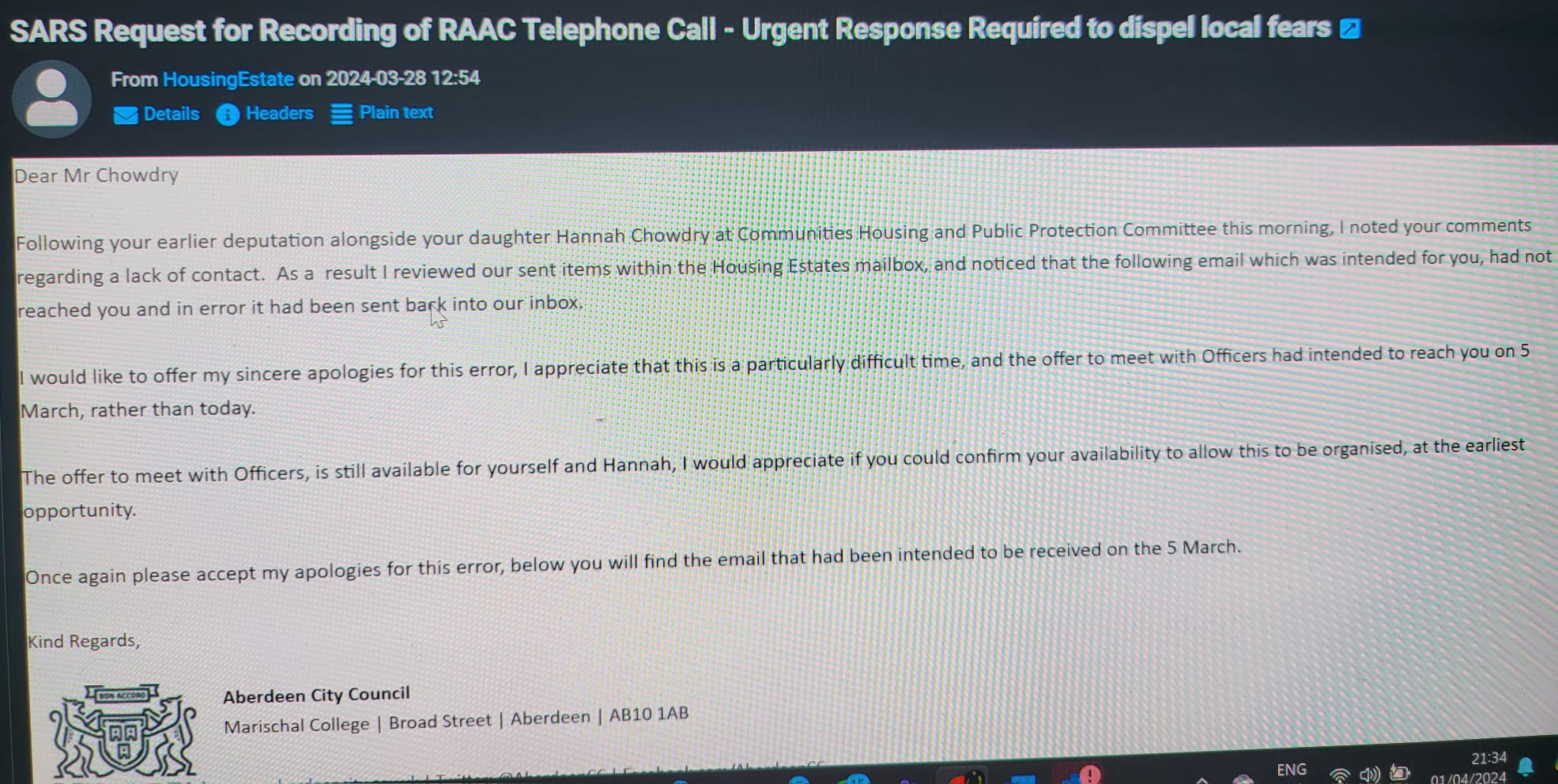
In the email mentioned above, ACC acknowledged and upheld a complaint lodged by Mr. Chowdhry regarding the absence of any response from November 2023 to February 2024, despite numerous emails and telephone calls, including some directed specifically to Stephen Booth, Chief Housing Officer.


Interestingly, following the deputation, a council officer investigated Mr. Chowdhry's claim of being inadequately communicated with and acknowledged yet another failure in communication.

Mr Chowdhry several times during the questioning expressed a desire for ACC to aknowledge that properties had been sold to unsuspecting buyers with a latent defect, he also clarified that their was a perceived lack of duty of care and negligence, for failure to undertake annual inspections after the BRE report in 1995 that suggests RAAC had a lifespan of 30 years. he 

The Q&A section was doubled from minutes to 20 minutes and only Cllr McLellan seemed to be unsupportive.

During the discussion, Cllr McClennan raised the issue of the council's obligation to disclose RAAC information to buyers of homes sold on the open market. Mr. Chowdhry tried to clarify that if Aberdeen City Council had fulfilled their duty by informing the initial ex-council tenants about RAAC, they would have been responsible for passing this information on to subsequent open-market homeowners like Hannah. However, since the council failed to inform anyone, the fault and consequent responsibility for addressing the current RAAC crisis rested with them. It appeared uncertain whether Cllr McClennan fully grasped this point, but it was even more astonishing that he attempted such a weak defence to shield the council's indifference to homeowner concerns. 

Mr. Chowdhry elaborated that the insurance policies paid for by homeowners were ineffective, as they now excluded any claims related to RAAC. He expressed concern that risk litigators would invariably connect RAAC to any claims to avoid payout. To underscore his argument, Mr. Chowdhry provided scenarios illustrating the potential ramifications.

After an extended 20-minute Q&A session, Hannah and Wilson Chowdhry left the chamber and joined the people of Torry in the public gallery. Unable to speak further, they watched as councillors and chief officers discussed progress with the RAAC crisis.

Ms. McKenzie, a housing officer, provided a verbal update during which she informed the CHPPC that a report would be presented to them as per the agreed process. She noted an increase in the stock available for relet, with 123 properties now ready to be offered. Emphasizing their commitment to mitigating the situation, she mentioned plans to undertake inspections as part of their strategy, [I assume this is likely aimed at identifying RAAC-affected properties, particularly those where tenants refuse to vacate due to safety concerns]. Currently, there are 214 applications on the RAAC priority scheme, with 33 offers generated directly and an additional 8 by social landlords. She highlighted some positive outcomes from these offers but notably omitted any mention of homeowners in her address.


Ms. McKenzie outlined their flexible approach regarding appointments and expressed hope that engagement with council tenants would be completed by the end of the first week in April. She stressed the importance of mental health and well-being, noting efforts to signpost tenants to mental health support services and assistance offered by the British Red Cross. Additionally, she mentioned outreach to community groups and cross-service support involving social services, education, and other departments to provide comprehensive assistance. Acknowledging the need to reintegrate affected individuals into new communities, she explained the limited housing stock available, managing expectations regarding relocation. To cope with the workload, new staff had been brought in.


Mr. Booth elaborated on technical solutions being explored, emphasizing the consideration of all options, including logistics, disruptions, costs, and timescales. He acknowledged that housing options would be covered by tenants' rents but did not address support for increased rents in some areas. Notably, only £1500 is offered for relocation costs, with nothing provided for the loss of investments in properties. Mr. Booth mentioned communication with other local authorities experiencing RAAC problems but indicated that ACC was further ahead in their process, potentially unaware of issues faced by residents elsewhere. He highlighted collaboration with national working groups, including NHS Estates and University Estates, and engagement with the Housing Regulator and Scottish Government for potential solutions.

Regarding communication efforts, Mr. Booth mentioned letter drops and leaflets distributed, with responses to further matters raised in the deputation promised for the week. He stated that survey reports were shared online for transparency and would be shared with residents and owners before any final decisions. Mr. Booth clarified that there was no current plan for a Compulsory Purchase Order and explained limitations on the council's ability to buy back properties due to revenue requirements [I believe this is referring to the fact that the council is not willing to buy back zero equity properties]. He addressed concerns about engineering inspection costs, stating homeowners' responsibility for their properties. Mr. Booth also mentioned issues around valuations and committed to seeking guidance from RICS to determine the best solution 'but would need to identify best solution and impact before knowing the impact on property values'.  This comment carries ominous implications, suggesting that the value of a Compulsory Purchase Order (CPO) offer will be determined based on property values at the time the CPO is announced. This aligns with concerns I had from the outset, especially after reviewing the Government guidance on the CPO process.

Finally, he spoke about communication with ABI and UK Finance regarding support for private owners, indicating forthcoming FAQs to address their concerns.

Councillor Mrs. Stuart, evidently sensing the gravity of the situation, empathized with the community, mentioning her own experience with homelessness in the past. However, her remark linking the protestors fighting for their homes to potential homelessness raised eyebrows and concerns among some attendees. She directed a question to Mr. Stephen Booth, the Chief Officer for Housing, asking if reasons beyond safety had factored into the council's decision to evacuate residents. It seemed she was following up on Mr. Chowdhry's concern that the evacuation and subsequent demolition might be influenced by significant investments in the surrounding areas. She also questioned the necessity of the evacuation itself a query that came up several times through other councillors. 

Mr. Booth's explanation centered on a report from Fairhurst Surveyors, highlighting a high risk of roof collapse, albeit not classified as critical. He emphasized that evacuation and remedial workwas necessary to comply with measures set by IstructE regarding high-risk situations.  You can read the IstructE guidance (here).

However, Mr. Booth did not confirm that all buildings were deemed to be in this high-risk state. The fact that homeowners have been permitted to remain in their properties suggests a belief that not all properties are in imminent danger. This position aligns with the Scottish Government's stance, as declared in a Topical Questions Committee session on 8th March. Mr. Booth also mentioned the BRE report of 1995, which purportedly indicated no substantial risk, yet he omitted any reference to their recommendations for roof maintenance or their advocacy for annual inspections.

Upon reviewing the IStructE guidance, it's evident that the 30-year lifespan assertion is misleading. The same guidance however, underscores the necessity of ongoing maintenance. It explicitly states:

 'If manufactured correctly, installed correctly, and appropriately maintained (for example no overloading and managing water ingress) throughout its in-use life then RAAC should perform comparably with similar materials.'  Read FAQ 3 (click here)

At the same meeting Mr Wilson Chief Capital Officer had stated:

“We became aware of Raac in public buildings in around August 2022,”

“We then started to investigate our current housing stock, and with regard to the presence of Raac in council houses [the council became aware ] around September 2023.

“It is correct to say it was the view of the council that these houses were built to building regulations and housing standards, up until then.”

I believe Mr. Wilson's assertion raises a valid point of negligence. It's unlikely that the council was unaware of the presence of RAAC in the properties when they were built. However, even if there was a period where oversight was lost and then regained, this doesn't release them from their responsibility to maintain the roofs or to inform buyers about the necessity of regular maintenance and inspections. In my view, there remains a clear duty of care that the council must uphold, regardless of any lapses in oversight.

Aligning with various local groups, Mr. Chowdhry and Hannah Chowdhry intend to compose a letter to ACC requesting further clarification on the necessity of the evacuation and insisting on obtaining a second opinion from qualified surveyors. They advocate for an open tender process that allows public participation in selecting the contractor.

Cllr Stuart mentioned a 'Missing Share' process that the council can implement in situations like this, where the council funds repairs and seeks reimbursement of these costs at the time of any property sale. Mr. Booth confirmed that this could be a possibility and would be a factor to consider once a final decision was made on the way forward.

Cllr Davidson inquired whether consideration had been given to temporarily relocating people and then returning them to their properties once a way forward had been determined. Miss MacKenzie responded affirmatively, stating that this could indeed be a consideration once a decision had been reached on the best course of action.

Earlier, Mr. Booth had asserted that they followed technical advice from Fairhurst, who are specialist surveyors in the field. However, he did acknowledge that properties vary in condition, indicating that not all are in the same state of disrepair.

Additionally, Mr. Booth mentioned that the Town House building also had RAAC roofing but was on a managed program. This raises the question of whether RAAC roofs could endure for an extended period if managed correctly. The management of RAAC roofing is evident in NHS estates and many other public buildings, suggesting that with proper maintenance, these roofs could potentially last longer.

At the conclusion of the Q&A session between the councillors and council officers, there was a brief period of reflection lasting for 5 minutes. Some councillors appeared visibly affected by the challenges faced by the Balnagask community, and many gathered in a huddle to privately discuss their thoughts away from the approximately 50 local residents in the public gallery. The allotted 5 minutes stretched considerably longer, with the deliberations extending for over 20 minutes before the councillors emerged with the following recommendations:


Essentially, the councillors reached an agreement that any tenants relocated from the Balnagask Estate would have the first option to return to their former homes. Additionally, they decided that any homeowners displaced from the estate would be given priority for relocation to any newly built homes within the estate. Furthermore, they have tasked the Chief Officers responsible for Corporate Landlord, Capital, and Housing to investigate funding opportunities to support owner-occupiers and to provide a report at the next committee meeting. While this offers a small glimmer of hope for all of us, it represents no substantial gain. Nonetheless, our advocacy for a fair resolution will persist.

Below is a quote I sent out to media groups post-decision.

"Our efforts have yielded some positive outcomes.

"There is now a significant opportunity for all Council Tenants affected by relocation, as they will be given priority to return to their original homes once they are repaired, should the Council decide against demolition.

"Additionally, they will also have the first choice to move into any new properties in the area should demolition be the chosen path. This ensures that those who were deeply connected to the local community can retain their links, undoubtedly contributing to the social well-being of many."
"For homeowners, there is a glimmer of hope as the council has tasked the Chief Officers – Corporate Landlord, Capital, and Housing – with exploring funding options to assist Owner Occupiers with their costs.

"A report will be presented at the next committee meeting, indicating a proactive effort to secure funding.

"While this isn't a guarantee, it represents a step forward from a complete absolution of responsibility. We can't afford to get too excited at this stage, and we will redouble our efforts behind our campaign.

"During the meeting, Chief Capital Officer Mr. John Wilson stated, "My understanding of the report by BRE in 1995 is that there was an awareness of RAAC, but no suggestion that RAAC posed a problem. Whereas, after recent collapses in England, we have responded."

"He explained that this led to the discovery of RAAC in public buildings in October 2022 and in Balnagask homes in September 2023.

"He later reiterated that he was not personally aware of any other involvement. In my opinion, ACC should have known about RAAC when they built the properties circa 1965. I do not believe that the fact they lost oversight of this RAAC material in homes absolves them of responsibility.

"The failure for them to inspect homes and public buildings after the BRE report seems negligent. To me, it would seem they had a duty of care to check these buildings before selling them to unsuspecting buyers.

"Moreover, their lack of identification of RAAC in 1995 meant that they failed to meet expected annual inspections. I think the council may want to seek legal clarity on their position based on the information provided by Mr. Wilson; local homeowners certainly will be looking into this."

Please sign our petition for the UK or Scottish Government to introduce a national fund for RAAC Homeowners and initiate a public Inquiry into the response of Councils across the UK (click here)

Friday, 29 March 2024

Uniting for Justice: RAAC Homeowners Across the UK Demand Action


Please sign our petition (here)  which extends beyond homeowners to anyone moved by the plight of RAAC homeowners across the UK

On Wednesday, March 27th, 2024, a meeting was convened at the home of Kerry Mackintosh, where 15 RAAC homeowners gathered. Kerry, who famously became one of only 10 homeowners from the former Deans South Estate to secure a 'house for a house,' hosted the meeting.

The attendees hailed from various areas in West Lothian, including representatives from the Chestnut Grove Homeowners Association (Craighill), the Little Boghead RAAC Action Group (Bathgate), A Fair Deal for Dean South Homeowners, as well as Hannah Chowdhry, Chair for Torry Community RAAC Campaign (TCRC), and her father Wilson Chowdhry, also a committee member.

L-R Kerry MacKintosh, Hannah Chowdhry and Wilson Chowdhry

During the meeting, Ms. MacKintosh recounted her distressing journey in obtaining an equivalent replacement house after her original home was condemned by West Lothian Council. She highlighted the disparity in compensation, with only 10 out of 86 homeowners receiving replacement homes. Many were offered low voluntary purchase prices well below the actual value of their properties or were presented with the option of a 75% shared ownership scheme with the Scottish Government. If homeowners did not accept either of these offers, they would face the dire prospect of their condemned buildings being demolished without any compensation, all while still being liable for their mortgages. Unfortunately, some individuals endured this fate. However, Kerry and a brave few, with the assistance of Reginald Forbes a local businessman, took action. They were able to initiate a public inquiry into the Council's operations and ultimately emerged victorious in 2010 (click here).

In a desperate situation Ms. MacKintosh often protested alone or with friends.

Ms. MacKintosh expressed the complex emotions she experienced following such a crucial victory. She remarked, "Winning was both joyous and distressing. While I was able to keep my home along with ten others, we found ourselves living in what felt like a Ghost Town—a place so marginalized that even basic council services were refused. The area was plagued by rubbish and rats, with few neighbours in sight. Worse still, the ten of us were continually threatened with demolition if we did not accept the measly offer or shared equity status. Adding to the ordeal, the water and electricity were switched off as West Lothian desperately attempted to force us out However, our plight was alleviated 7 years later through the generosity of the developers, Springfield, who offered myself and the other nine residents a 'home for a home.' I am eternally grateful to Springfield for temporarily housing two of  us whose properties they needed immediately, while they construct our new homes." 

Kerry documented the deterioration of her estate

Of the eight others who are assured new houses, only four currently reside in the old estate. However, their situation has notably improved since Springfield's involvement. Springfield ensures cleanliness, enacts pest control when necessary, and maintains the gardens. During the construction phase, they are diligent in minimizing disruption to the residents' lives as much as possible

Ms. MacKintosh's suspicions of corrupt practices in the valuation process were voiced, with plans to gather evidence to hold responsible parties accountable. She also raised concerns regarding the legality of the offer process, suggesting that outdated legislation might have been used improperly.

Kerry watched as roofs fell of the houses around her as 10 brave families lived on in a ghettoized community.  Their dreams of a safe home were shattered.

Lynne from Bathgate informed the meeting that the issue in her area should have been resolved 20 years ago when the council discovered Siporex, a brand of RAAC. However, rather than replacing the roofs, the council initiated a program of creating tilts on flat roofs by installing a wooden structure above to allow rain runoff. Residents were not informed why these coverings had been installed, leading to confusion and concern among homeowners.  

In response, Mr. Chowdhry explained to attendees that at a community meeting held in Torry, residents raised concerns that the council may have known about RAAC five years ago when they began a program of adding pitched roofs to some council homes. The whistleblower had speculated that although the roofs were ostensibly installed for improved insulation, they may have been installed to conceal or protect the RAAC material.

Margaret Speedie, from Bathgate, shared her ordeal, she said:

"I first moved into my home in Dalling Rd about 42 years ago as a council tenant with my husband, son and daughter. 

"Once my children were secondary school age I started work and we decided to buy our home through the right to buy scheme in October 1997. Have been a homeowner for 26 years. 

"The council had replaced the flat roof with a Built up Felt system with Green Mineral finish so water ran off to guttering at front of house about 1995.

"I can’t recollect ever having a leaking roof prior to the new felt being installed and certainly have had no problems since. 

"We recently had roof inspection done as requested by my insurance company. 

"Everything in order and guy reckons that it has another 10 yrs of life in it though he recommends that it’s inspected every 2 yrs."

"My ceilings upstairs are Raac panels with an artex type finish, they look fine, and have no cracks or discolouration. 

"My garage roof also has Raac panels , is part of my house which has a bedroom above. 

"It was a shock to receive a letter from council informing us of how they thought we should proceed . 

"I don’t see why we have to pay for a survey, we know we have RAAC panels - having intrusive surveys done will weaken the structure.

"Roof replacement seems the way to go albeit a huge disruption. 

"Homeowners as you are aware face huge costs in doing so."


A list was compiled of the number of affected homeowners across various groups:

1. Torry Community RAAC Campaign: Approximately 150 affected homeowners.

2. A Fair Deal for South Deans Homeowners: 86 affected homeowners, with 10 of them slated to receive new homes.

3. Little Boghead RAAC Action Group, Bathgate: 60 affected homeowners.

4. Chestnut Grove Homeowners Association, Craigshill: Initially reported 12 affected homeowners, but more are believed to exist in the Craigshill area.

Ashleigh Mitchell explained how the crisis affected her more than other residents. She emphasized that her walls and roofs were constructed from RAAC, heightening the danger and risk of her home collapsing. This revelation surprised the visitors, as it was the first they had heard of houses made entirely of RAAC, raising questions about the prevalence of such homes elsewhere.

Ashleigh also expressed concern about the estate being owned by Almond Housing Association. On their website the Housing Association disclose that a total of 318 properties on the estate contain RAAC. However, the majority of these properties have pitched roof coverings and are not believed to be at high risk. Nevertheless, there are 12 properties with flat roofs, all of which have allegedly been sold to owner-occupiers, and 7 of these have RAAC walls and roofs. These 7 properties have a higher risk of structural instability and require a more urgent solution.  Read the Almond Housing Association statement (here).


Ms. Mitchell expressed her existing concerns, stating, "All local families are left in limbo; neither the local council nor housing association are helping us. The local housing association is not disclosing their intentions regarding their properties. We fear being left in a ghettoized area like Kerry's. I bought my home in 2013, years after the 2004 report. Surely, Almond Housing or West Lothian Council are responsible for the situation I am in and should rectify it. They sold the property to an unsuspecting buyer without disclosing the presence of RAAC. They couldn't inform me about the problem because they were unaware themselves. If I had known, I would never have purchased the home."

Every visitor reported that their local council was providing no support to homeowners. They all shared similar concerns about insurance companies, which continued to accept payments for insurance policies that would ultimately prove futile in the event of a claim involving RAAC. Homeowners believed that insurance adjudicators would find ways to avoid settling claims related to RAAC issues, adding to their frustration and sense of helplessness in the face of the crisis.

The group agreed on three shared aims:

1. To challenge the National Government and UK Government to establish a national fund for RAAC homeowners. This fund would provide financial assistance and support to affected homeowners dealing with the consequences of RAAC in their properties.

2. To advocate for a public inquiry into the practices of councils and housing associations concerning RAAC. This inquiry would investigate how these entities conducted business related to RAAC, including the handling of property sales, disclosure of RAAC presence, and the response to homeowner concerns.

3. To demand acknowledgment from councils and housing associations that their processes regarding RAAC were inherently poor. This acknowledgment would serve as a crucial step towards accountability and transparency in addressing the challenges faced by RAAC homeowners.

Hannah Chowdhry, Chairperson for the Torry Community RAAC Campaign, expressed her concerns, stating: "It was apparent from the scale of the RAAC schools crisis that RAAC was a significant problem. When public buildings everywhere were found to contain RAAC, it became a UK-wide concern. So, when I received the letter through my door, I knew that homes across the country and the UK were affected.

"What has shocked me the most is the prevalence of the problem before RAAC was identified. When I realized that homeowners like Kerry had similar problems almost 20 years ago and nothing was done, it was deeply troubling.

"Hearing accounts from the large group that was present at the meeting in Livingston, I was alarmed at just how much councils, the Scottish Government, and the UK Government have ignored the plight of victims like Kerry.

"Justice must be served. We live in a proud democracy, not a feudal state, and people's rights have been trampled on. I hope people support our petition and demand a public inquiry for all affected homeowners, past and present."

Wilson Chowdhry, Committee Member for TCRC, emphasized the gravity of the situation, stating:

"Kerry, Ashleigh, and many others shared heartbreaking stories with us.

"People have been left in a financial and social crisis because of the cold-hearted ignorance of the councils and government in positions meant to protect them.

"The UN Charter for Human Rights protects the right to an adequate standard of living, and the UK as one of the founding 51 nations has ratified it. Now, our government must uphold the principles of that charter!

"The government has, on numerous occasions, supported the banking industry and others to the extent of millions of pounds. Now they must set up a national fund for RAAC homeowners and deliver a public inquiry into how councils up and down the country have reacted to the RAAC crises, not just now but historically.

"Justice must be served!"

Please sign our petition (here)  which extends beyond homeowners to anyone moved by the plight of RAAC homeowners across the UK

Article 11 (1) of the The International Covenant on Economic, Social and Cultural Rights (ICESCR) was adopted in 1966 and has been ratified by 153 States. The UK was one of the nations to subscribe to this international law, which states:

The States Parties to the present Covenant recognize the right of everyone to an adequate standard of living for himself and his family, including adequate food, clothing and housing, and to the continuous improvement of living conditions. The States Parties will take appropriate steps to ensure the realization of this right, recognizing to this effect the essential importance of international cooperation based on free consent."

Wednesday, 27 March 2024

Solidarity in Defending Our Homes: Embracing the 'We Shall Not Be Moved' Declaration in Torry

In a fervently attended public meeting comprised of approximately 100 residents from Torry, the community has reaffirmed its commitment to resist and condemn the reprehensible actions of the Aberdeen City Council, which are perceived as threatening the livelihoods of numerous homeowners.

Emerging from this gathering, a new Residents Association/Campaign Group has been established, with elected representatives poised to spearhead the advocacy efforts. Hannah Chowdhry, a 19-year-old law student at Aberdeen University, assumes the role of Chairperson, bringing youthful energy and legal acumen to the forefront. Serving as Secretary is Amie Bruce, a respected local school teacher, whose organizational prowess will be invaluable. Lynne Winstanley, leveraging her background in accounting, takes on the responsibilities of Treasurer, ensuring sound financial stewardship within the group.

Furthermore, Wilson Chowdhry, father of Hannah Chowdhry, and Quentin McFarlane, father of another resident, have been democratically elected onto the committee, initially proposed as co-opted members but enthusiastically embraced as full members by attendees. Their inclusion underscores a multi-generational and inclusive approach to leadership.  

L-R Lynn Winstanley, Amie Bruce, Quentin McFarlane, Wilson Chowdhry, Hannah Chowdhry.  

Quentin McFarlane has since resigned from his post for personal reasons but will be attending our protest.

The Constitution for the group will need to be ratified at a future meeting and a draft from which the group will be working will be emailed to all those who attended.

The group made some clear progress on a vision for local homeowners First on the agenda was a discussion on group litigation and unanimous support was given for a proposal to seek advice on action against Aberdeen City Council (ACC) for selling a property with a latent defect and for negligence and duty of care in regard to maintenance post-BRE (British Research Establishment) findings in 1995, that declared RAAC unfit for purpose resulting in the termination of the material in any UK council projects by 1996. Two residents have agreed to share details of costs and advice provided by property law advocates they have been speaking with and the TCRC would also be seeking to obtain information pertaining to a number of visits by local people to Grampian Community Law Centre that provide pro bono legal advice to those whom it was normally inaccessible. GCLC have collated questions raised and are seeking answers from ACC.

https://www.rgu.ac.uk/news/news-2022/5411-grampian-community-law-centre-prepares-for-torry-launch-in-scotland-first

It was brought up at the meeting that some property were sold from council stock before the 1995 BRE report. However, the majority of the visitors raised their hands to indicate that they had bought their properties from the council and that they had never been told about RAAC.  A similar number also raised their hands to state they had bought their properties after 1995. Wilson Chowdhry urged homeowners who did not purchase properties directly from councils to seek a date from either the Land Registry of Scotland or Aberdeen City Council, who had provided him with this information for his daughters property.

A whole raft of complex issues exist and the community is left confused with what action to take. some properties abut onto existing Council-owned properties, leaseholder rights where the council is freeholder and problems related to s the New Supply/Open Market Shared Equity and shared Ownership routes that involve the Scottish Government holding some equity in bought houses mean people do not know what will happen if the council goes ahead with their plans to demolish homes. The shared equity programmes  especially make remortgaging very difficult and Hannah Chowdhry agreed to put a question about this to Aberdeen City Council at the Communities Housing and Public Protection Committee (CHPPC) on 24th March 2024 and local MSP's via email.

Ateendees agreed that any collective litigation advocate selected would work equally diligently for all homeowners. 

Hannah Chowdhry, explained that she had applied for evidence of ACC's annual inspections of RAAC roofs, a requirement set in the BRE-report, her submission to the Communities, Housing and Public Protection Committee on 28th March. She had also asked for failure to provide it should be acknowledged as a failure to comply with the direction.

Several decisions were made, primarily it was unanimously agreed that once advice had been received from the initial legal inquiries, the group would engage with and commission a legal advocate. The majority of people in the room agreed to contribute to a fund.  The group also sought to make any claim parallel claim to any brought about by council tenants.

It was agreed that the committee would seek to open a group bank account expediently and that they would revisit the current Crowdfund initiated by British Asian Christian Association and be the lead organisation for it, going forward.  Hannah Chowdhry, has since contacted the Trustees and thanked them for raising the profile of the appeal and campaign.  BACA has stated they will send all donations raised and any gift aid payments to TCRC, once they have established a bank account.

Mr McFarlane raised concerns about how the council were responsible for building the RAAC riddled homes and should be made accountable. He asked the gathering what they felt ACC would do with all the homes they were evacuating.

Mrs Winstanley, was concerned that residents from Council houses would be moved out into new permanent homes, meaning that the council would have empty homes which would best be removed by demolition. A show of hand illustrated the majority of people believed that ACC would demolish their housing stock.

Even then, residents agreed unanimously that we must seek full repair of roofs as a priority and for a fair valuation of properties if compulsory orders were enacted.  A show of hands also indicated that homeowners would be willing to move if a fair offer was provided.

He urged people to stay strong and remain in their houses until they got a fair result. 

Mr. McFarlane gave a rousing shout of 'We shall not be moved!' the rallying call led to a series of cheers.  

A few years ago the council embarked on a strange programme of building roofs over the RAAC inclined roofs. Thes roofs were meant to have been installed for heat insulation purposes but some homeowners questioned whether the purpose was in response to known RAAC deterioration. The new roofs cost £13,000 to the homeowners who were now being expected to pay out a further similar amount to make their homes safe.  Accounts of new windows and heating systems in houses that are in essence to be demolished, seemed like a total waste of money and may have been due to different departments not having been told of the RAAC decision.  A worrying state of profligacy became a concern and Hannah Chowdhry agreed to table a further question into her deputation to get to the bottom of this conundrum.  

Over 40 people at the meeting confirmed they would be attending the protest at 9am on 28th March.  In addition Wilson Chowdhry, stated he would be organising a bagpiper to lead the protestors into the Town house to hear as Hannah delivers her deputation to the CHPPC. Hannah Chowdhry, explained to the gathering that she had been speaking to her University Students Union and that they were very supportive and would be interviewing Hannah to bring her campaign to students and would encourage students on campus to sign our petition and join our protest.

During the meeting, Wilson Chowdhry shared insights from his conversation with Kerry Mackintosh from South Dean RAAC Homeowners, who had successfully campaigned for a new house after an arduous 18-year struggle against West Lothian Council. He recounted Ms. Mackintosh's disappointment at the outcome, revealing that out of 86 homeowners, only 10 had their homes replaced. Many in her community faced the distressing reality of having their homes condemned and receiving meager compensation for their sale under deeply upsetting circumstances. Some were coerced into accepting as little as £18,000 for homes that should have rightfully fetched £100,000. Threats were made that they would receive nothing if they didn't comply.

Mr. Chowdhry emphasized Ms. Mackintosh's advice to the families of Torry: to stand firm and refuse anything less than a replacement home if forced evacuations were to occur. In light of this, Wilson and Hannah will be meeting with Kerry in her home on Wednesday evening, joined by leaders from two other groups, including Livingston RAAC Homeowners and Bathgate RAAC Homeowners, to discuss collaboration and draft a joint statement.

I'm pleased to inform you that all three groups have now endorsed Hannah's petition, and with their support, we have nearly reached 700 signatures.  You can still sign this petition now by clicking (here).

People were asked about their interactions with Audrey Nicoll, and many expressed disappointments with the outcome, as it seemed unlikely that she would offer much assistance. However, Hannah Chowdhry shared positive news that MSP Douglas Lumsden had sent a letter supporting the underwriting of homeowner insurances and providing grants towards initial inspections. This initiative would not only offer homeowners some security but also enable the Scottish Government to distribute the costs for replacing roofs. It's important to note that this is just one option that TCRC is pursuing in their efforts to address the RAAC crisis.

Additionally, Michael Marra has sent several letters to Hannah, challenging the Scottish Government on funds being allocated to help with the RAAC crisis. 


Hannah Bardell MP for Livingston recently raised a question during Prime Minister's Question Time, which is expected to lead to a conversation with him. This development presents a significant opportunity to directly address the RAAC crisis at the highest level of government and advocate for much-needed support and action.


During the meeting, most residents confirmed that their insurance remained in place, albeit with caveats that RAAC-related problems would not be covered. To address this issue, the Torry Community RAAC Campaign (TCRC) is compiling a list of insurance companies that are acting favourably in this regard. This list will be shared with all members, providing valuable information and guidance for homeowners navigating insurance matters related to RAAC.  We will also be monitoring behaviours during renewal.

Since the meeting, Hannah Chowdhry has taken proactive steps by writing to UK Prime Minister Rishi Sunak, MP Michael Gove, Secretary of State for Levelling Up, Housing and Communities, MSP Paul McLennan, Minister for Housing for Scotland, MS Julie James, Cabinet Secretary for Housing, Local Government and Planning for Wales, and Gordon Lyons, Minister for Communities for Northern Ireland. In her letters, she urges them to consider the establishment of a national fund to provide support to homeowners affected by RAAC. Additionally, she calls for a public inquiry to investigate the role of local councils across the UK in contributing to the current RAAC crises. These actions demonstrate her commitment to advocating for justice and support for those impacted by this pressing issue.

Here is a video of Amie Bruce talking with GMTV about the RAAC Homeowner issue:


Tuesday, 19 March 2024

Homeowners of Torry boosted by confirmation that Insurance companies will continue to insure homes despite Aberdeen City Council RAAC decision


SIGN OUR PETITION (HERE)

Aberdeen City Council (ACC) has declined to offer assistance to homeowners who purchased former council properties constructed with Reinforced Autoclaved Aerated Concrete (RAAC) in their roofs. This is despite the risk of collapse.

Certain homeowners suspect there may be undisclosed motives behind ACC's decision, particularly in light of their consideration to demolish existing Balnagask council homes. For further details, please refer to the linked article (here).

A steering group has established the Torry Community RAAC Campaign Residents Association to unite homeowners affected by RAAC issues. A public meeting is scheduled for March 24th, 2024, where a temporarily appointed Executive Committee will seek ratification. While elections are ongoing, we are actively seeking two additional members for the Executive. The details of the event are as follows:

Name: Inaugural TCRC

Meeting Date: March 24th, 2024

Time: 6:00 PM

Location: The White Cockade, 2 Oscar Rd, Aberdeen, AB11 8ER.

A comprehensive update on the current situation of homeowners was provided last week. For further information, please refer (click here).

Since our last update, TCRC has been diligently working behind the scenes to advocate for fair treatment for local Balnagask homeowners. Hannah Chowdhry has persistently reached out to local MPs, and we are pleased to report a response from Liam Kerr, one of the MSPs for North East Aberdeen. According to an email from his assistant, it appears that concerns about cancellations of insurance policies are no longer a threat. She shared a response from the Association of British Insurers (ABI):

"We’re aware of the RAAC problems in Balnagask and have been in discussions with ABI member firms and Scottish Government officials on it. ABI has issued guidance to help residents understand the insurance position, but it’s up to individual insurers to decide their commercial appetite for insuring properties affected by RAAC, although the majority of ABI member firms have said they will not cancel policies where RAAC is present. Constituents can shop around to obtain landlord insurance from another carrier but will need to disclose the presence of RAAC in their properties. Constituents may wish to use the British Insurance Brokers Association Find Insurance Service to identify a specialist in landlord insurance cover. " 

"If a policyholder is concerned about the presence of RAAC in their building, they should contact their insurer to discuss the matter further.

The majority of Association of British Insurers member firms are not cancelling policies due to the presence of RAAC in homes in Balnagask, and insurers will consider the renewal of home insurance cover for properties with RAAC. If constituents are concerned about what the presence of RAAC in a building might mean for the future of their insurance cover, they should contact their insurer. 

Domestic building insurance policies are generally designed to cover damage from named perils such as storms, floods, subsidence, or damage from theft.  Homeowners should still be able to claim on their insurance policies if they suffer damage from these perils.

Home insurance is not generally designed to cover wear and tear in a building, damage caused by defective materials, or damage that happens gradually over time. They are not intended to cover design or build defects or to replace construction materials that are gradually deteriorating over time. So, the replacement of RAAC is not likely to be covered.

The Association of British Insurers is discussing the situation in Balnagask with its property insurer members and they understand it is a priority for local parliamentarians, Aberdeen City Council and the Scottish Government.

If your constituent feels that they have been treated unfairly by their insurer, they can first raise this with their insurer through their complaints process. Should the outcome of this be unsatisfactory, they can contact the Financial Ombudsman Service (FOS), which is an impartial adjudicator that has the legal power to award redress when someone has been treated unfairly and can arbitrate on cases. The FOS can be contacted on 0800 032 8000 or at https://www.financial-ombudsman.org.uk/.

Following a distressing incident where a local homeowner received a 14-day cancellation warning from a less scrupulous insurer, many residents in our community were understandably alarmed. However, we are pleased to note that several insurance companies have provided more positive responses to many other local residents. To streamline the process for homeowners affected by the RAAC crisis, we will be compiling a list of insurance companies that have demonstrated favourable attitudes towards our community. This list will aims to facilitate easier identification of suitable insurance options when existing policies expire.  

From the ABI email, It’s evident that our current and any future insurance coverage for homes does not extend to issues related to RAAC, creating a significant concern for homeowners in our community. However, there is a glimmer of hope as they state they are in priority discussions with local parliamentarians, Aberdeen City Council, and the Scottish Government on this pressing matter. It's a vague statement, but we will continue to monitor these developments closely.

In the meantime, Hannah has taken proactive steps by reaching out to all MSPs, local councillors, and MP Stephen Flynn, urging them to consider underwriting claims for RAAC for homeowners. This approach would allow for spreading the cost over a longer period, with claims processed as and when needed. Hopefully, this makes the expense more viable for ACC and will trigger a response that fulfills their moral obligations. Additionally, accompanying the underwriting with a grant for the initial inspection, which involves the installation of intrusive hatches into ceilings, would make regular annual inspections for homeowners much more financially viable. Hannah will be sharing responses from all politicians who choose to reply, keeping our community informed of progress on this crucial issue.

Some residents have inquired about the potential cost of replacing our existing RAAC roofs with wooden ones. After consulting with a local surveyor, it has been confirmed that the estimated cost would range between £15,000 to £20,000 per home. Undoubtedly, this presents a significant financial burden for most of us.

Furthermore, the surveyor highlighted that most councils prioritize the preservation of local housing stock and would only consider demolishing homes as a last resort. Given the existing shortage of homes in Aberdeen (click here), preserving housing stock should be a local priority. Additionally, considering the number of our homes that share roofs or are adjacent to council homes, the surveyor speculated that once renovation projects commence, the Council may opt to extend the renovation work to homeowner houses as well. While this is speculative, it provides some hope for our situation.

Hannah's personal meeting with MSP Audrey Nicolls on 18th March 2024, proved to be disappointing as not all of her questions were adequately addressed, and the response seemed to reiterate that homes with RAAC are solely the responsibility of the homeowners who purchased them. We will be preparing a blogpost on this matter for further discussion.

Despite facing an uphill battle, we must remain focused, united, and steadfast in our goals. To this end, we urge all residents to attend our meeting on March 24th, 2024. Your participation and support are crucial as we navigate through these challenges together.  I would also like to remind everyone about the protest scheduled for March 28th outside Marischal College. Hannah will be leading our efforts to demand a fairer outcome before councillors during a Community Housing and Public Protection Committee meeting. We have received confirmation of attendance from the Press and Journal, BBC, and STV. To make this event a success and effectively convey the sense of betrayal we feel from local authorities, we need as many participants as possible to join us. This is a significant opportunity for us to raise awareness and advocate for the justice our community deserves.

Event: TCRC Protest

Date: 28th March 2024

Time: 9am

Location: Marischal College Broad St, Aberdeen AB10 1AB

If you missed my message on Facebook, I urge you to search for your property value on Zoopla and keep a record of it. While I hope for the best outcome, it's prudent to be prepared in case things do not go as planned and we are faced with a Compulsory Purchase Order. Your property value record could prove to be useful in such a scenario. 

MSP Liam Kerr has shared details of two questions he submitted to the Scottish Government along with their response, which are displayed at the end of this post. Despite the responses received, it's crucial not to be discouraged as our campaign is just beginning. I urge everyone to remain resilient and continue to sign and share our petition. Remember, the petition can be signed by anyone in support of our cause, not just residents of Aberdeen. Together, we can amplify our voice and drive positive change. Let's keep pushing forward with determination and perseverance.

SIGN OUR PETITION (HERE)

8 March 2024

Index Heading: Communities

Liam Kerr (North East Scotland) (Scottish Conservative and Unionist Party): To ask the Scottish Government when it last met with Aberdeen City Council to discuss reinforced autoclaved aerated concrete (RAAC).

S6W-25753

Shirley-Anne Somerville: The Minister for Housing and officials met with the Housing Convenor of Aberdeen City Council and officials on 4 March. Meetings routinely take place at official level including through engagement on the Housing Sub-group of the SG-led Cross Sector Working Group.


Liam Kerr (North East Scotland) (Scottish Conservative and Unionist Party): To ask the Scottish Government what funding it (a) has allocated and (b) plans to allocate to Aberdeen City Council to assist with the local authority's investigatory works in relation to reinforced autoclaved aerated concrete (RAAC).

S6W-25754

Shirley-Anne Somerville: As primarily a building maintenance issue it is the responsibility of building owners to maintain their properties. Local authorities manage their own budgets and allocate financial resources on the basis of local needs and priorities, having first fulfilled their statutory obligations and jointly agreed national and local priorities